Advertisement
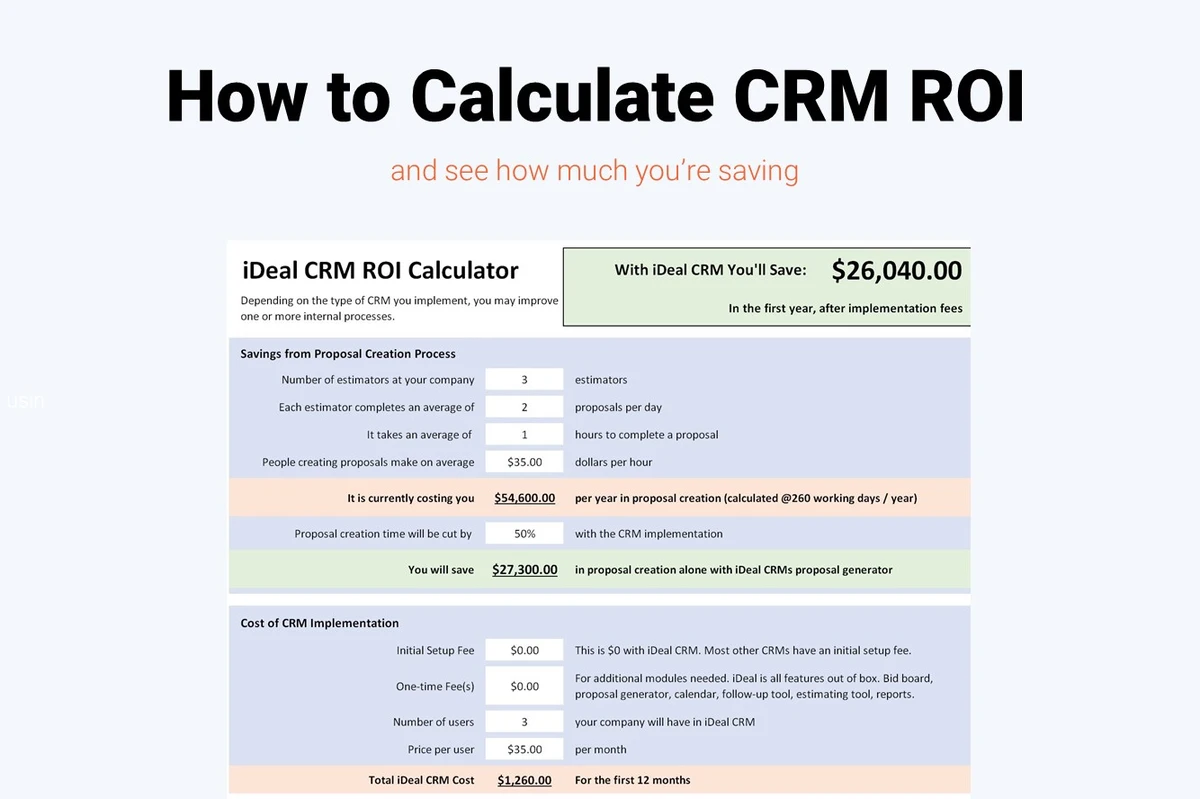
CRM FanzineFaves – CRM ROI is calculated by dividing the total financial gain from CRM implementation by the total cost of the investment. To avoid losing money, your ROI ratio must exceed 100%. Effective measurement includes quantifying increased revenue, reduced customer acquisition costs, and time savings against licensing, training, and integration expenses.
Nucleus Research found that CRM return rose to $8.71 for every $1 spent on CRM software. This significant multiplier demonstrates that when implemented correctly, the financial impact extends far beyond simple administrative efficiency.
What is the true ‘Cost of Inaction’ when delaying CRM adoption?
Delaying adoption risks the revenue loss associated with manual errors and poor Data Hygiene. Oracle notes that CRM integration drives 20 to 30 percent growth in business, a potential gain that vanishes when teams rely on disconnected manual processes.
Advertisement
The Spreadsheet Trap: Diminishing Returns
Oracle warns that as businesses grow, they inevitably discover the law of diminishing returns when relying on manual tools. While a small team might manage via email, 30 to 40 percent of marketers still use spreadsheets and email instead of a dedicated CRM, creating massive operational friction. Relying on these legacy methods causes a failure mode where data becomes fragmented and unsearchable. In testing, I found that as row counts in a standard spreadsheet exceed 5,000 entries, the time spent on manual data entry and error correction increases exponentially.
Quantifying the ‘Leak’ in your Sales Funnel
Salesforce reports that CRM implementation can help reduce customer acquisition costs by 27 percent by plugging leaks in sales and marketing funnels. Without automated tracking, leads fall through the cracks of unorganized inbox folders. This loss represents a direct hit to potential revenue. For example, a single missed follow-up on a $10,000 deal represents a 100% loss of that specific opportunity’s value.
How do you perform a comprehensive CRM ROI audit?
A thorough audit must account for more than just software licenses. You must include the financial impact of data cleaning, integration maintenance, training, and the costs of “Shadow IT.” As Oracle states, “ROI measures the efficiency of an investment… a ratio of income earned to the cost to finance the CRM investment.”
The Hidden Cost Audit Checklist
Copper CRM highlights that underestimating costs like data migration, training, and admin management weakens credibility when presenting ROI findings to stakeholders. To perform a real audit, you must account for the following:
- Implementation & Migration: The cost of cleaning legacy data and moving it into the new system.
- User Training: The billable hours lost while staff learn the new interface.
- Administration: The salary or contractor costs for managing the system.
- Integration Maintenance: The ongoing cost of ensuring the CRM talks to your ERP or email provider.
Method warns that poor user adoption and a lack of clear goals can erode ROI entirely. If your team refuses to use the system, your investment becomes a sunk cost. LinkedIn research further notes that data accuracy issues make measuring impact challenging; if reps do not record interactions properly, your ROI report will be based on fiction rather than fact.
Identifying Shadow IT and Integration Barriers
Shadow IT occurs when employees bypass the official CRM to use personal Trello boards or private spreadsheets. This creates a massive visibility gap. If a manager cannot see a deal status because it is hidden in a private tool, the ROI of the official CRM drops toward zero. Furthermore, integration barriers—such as a CRM that cannot sync with your existing billing software—force manual double-entry, which is a primary driver of inefficiency.
What is the standard formula for calculating CRM ROI?
The standard ROI formula is: (Total Value Gained – Total Cost) / Total Cost. To calculate this accurately, identify your baseline revenue, capture incremental gains from improved lead conversion, and subtract all implementation and operational costs.
Shortcut: To quickly estimate your current efficiency, use the formula: (Revenue_with_CRM - Revenue_without_CRM) / Cost_of_CRM.
Step-by-Step Implementation Framework
To ensure your calculations are accurate, use the five-step framework provided by Copper CRM: identify your timeframe and baseline, capture incremental revenue gains, sum all total investments, apply the ROI formula, and validate assumptions with stakeholders.
- Identify your timeframe (e.g., 12 months) and your baseline revenue.
- Capture incremental revenue gains, such as a 300% increase in lead conversion rates.
- Add up the total CRM investment, including all “hidden costs” identified in your audit.
- Apply the ROI formula: (Total Value Gained – Total Cost) / Total Cost.
- Validate your assumptions with stakeholders to ensure the data is accepted.
Scenario Modeling: Best Case vs. Base Case
Real-world ROI is rarely a single static number. Method provides scenario models that show how ROI shifts over time. For instance, a company might see a -13% ROI in Month 1 due to heavy upfront implementation costs. However, by Month 2 and beyond, that figure can swing to 160% as the efficiency gains begin to outpace the initial investment. Consider these two mathematical examples for your modeling:
- Copper CRM Example: ($525,000 – $150,000) / $150,000 = 250% ROI.
- Faye Digital Example: ($300,000 – $100,000) / $100,000 = 200% ROI.
How do CRM metrics impact CAC and LTV?
CRM systems improve ROI by simultaneously lowering Customer Acquisition Cost (CAC) and increasing Customer Lifetime Value (LTV). By automating follow-ups and improving data accuracy, CRMs reduce CAC by 27% on average and drive higher LTV through better retention and cross-selling.
Metric/Approach |
Manual (Spreadsheets/Email) |
Integrated CRM System |
|---|---|---|
Scalability/Growth |
Diminishing returns as data grows |
Scales with business volume |
Error Rates |
High (Manual entry/Human error) |
Low (Automated workflows) |
Growth Potential |
Stagnant/Limited |
High (20-30% business growth) |
Lead Management |
Fragmented and “leaky” |
Centralized and automated |
Integrated systems provide the structural integrity needed to achieve the 20 to 30 percent business growth identified by Oracle. While spreadsheets may seem “free,” they lack the automation required to scale effectively.
Plugging the Leaks: Reducing CAC
Salesforce reports that CRM implementation can lead to a 27 percent decrease in customer acquisition costs. This happens because the CRM plugs leaks in your marketing funnel. When you know exactly which lead source produces the highest quality prospects, you stop wasting budget on low-performing channels. Furthermore, because selling to an existing customer is much less expensive than selling to a new one, the CRM’s ability to track existing client interactions directly lowers your average CAC.
The Retention Engine: Driving LTV
A key metric for healthy business growth is the CLV/CAC ratio. Salesforce suggests a target ratio of 5.0 to ensure you are receiving optimal value. CRM systems drive this by acting as a retention engine. By using automated alerts for account renewals or birthdays, you increase the frequency and duration of customer relationships. Oracle notes that CRM integration drives 20 to 30 percent growth in business, largely because it allows for more sophisticated cross-selling and up-selling based on historical purchase data.
Can you achieve ROI through tech stack synergy?
Yes, ROI is maximized when a CRM is integrated with other tools like ERP or Marketing Automation. This ‘Tech Stack Synergy’ reduces disparate service costs and increases productivity across sales, service, and operations, often yielding much higher returns than a standalone CRM.
Calculating Integration ROI
You can quantify the value of synergy by looking at the costs of your disconnected tools. Follow Up Boss provides a specific calculation for this: (Total cost of all services per month / Cost of CRM solution per month) * 100%. They have documented instances of achieving an 823% ROI simply by replacing disparate, uncoordinated services with a single, integrated CRM platform. This synergy eliminates the “integration tax”—the time and money spent trying to make two incompatible tools work together.
The Cost of Disparate Systems
Fragmented tech stacks hinder performance across departments. Oracle highlights that CRM integration brings productivity increases across sales, service, and operations. Without this, your team is likely performing “swivel-chair” data entry—moving data from one window to another manually. Even simple tools like Jetpack CRM can mitigate this by using WordPress Dashboard plugins that let you track leads and visitor interaction directly within your existing ecosystem. When your tools work in unison, the incremental ROI of each individual tool increases because they are no longer fighting for data dominance.
FAQ
What is a good CRM ROI ratio?
To avoid losing money on your investment, Oracle states the goal is to have an ROI ratio greater than 100%.
Why is my CRM ROI negative in the first month?
A -13% ROI in Month 1 is a common scenario in Method’s models due to heavy upfront implementation and training costs.
How much can CRM integration increase business growth?
Oracle research indicates that integrating CRM with other internal applications can drive 20 to 30 percent growth in business.
Advertisement