Advertisement
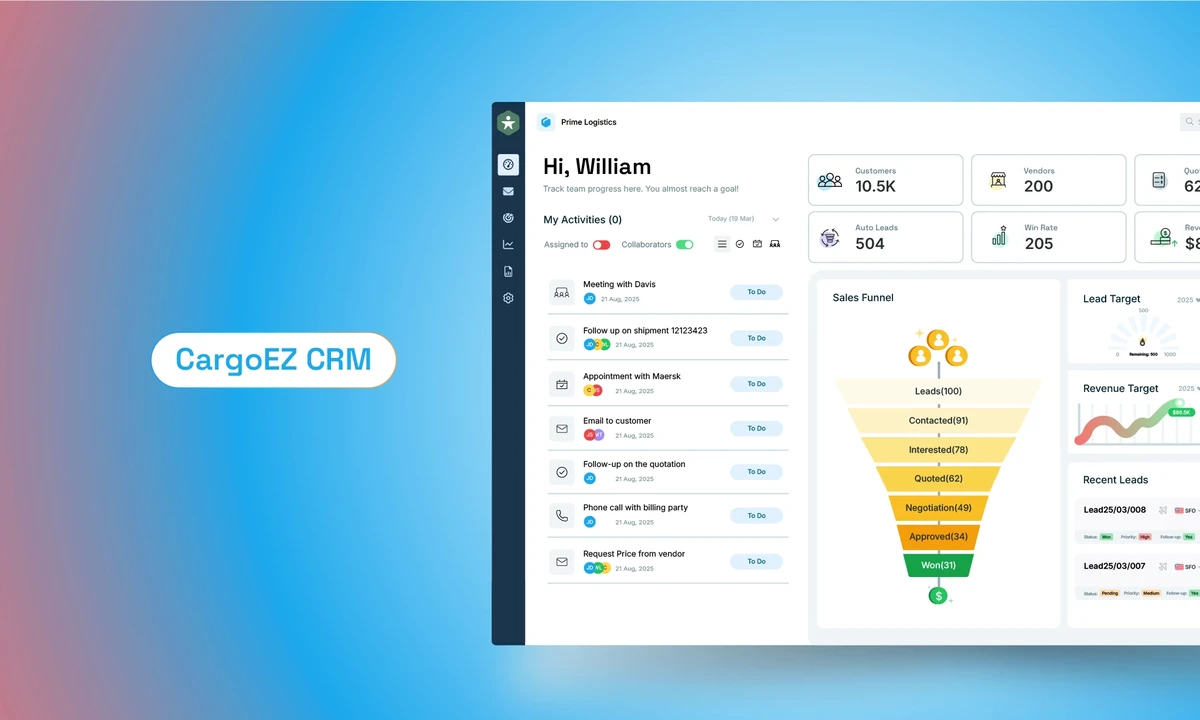
CRM FanzineFaves – A logistics CRM is a specialized software solution that integrates customer relationship management with supply chain operational data. Unlike generic CRMs, it captures shipment IDs, freight routes, and carrier contacts to automate workflows like quotation generation and real-time tracking, ultimately reducing direct operational costs by up to 25%.
Implementing an appropriate CRM solution results in 25% reductions in direct costs.
Why do generic CRMs fail in high-stakes logistics environments?
Most CRMs lack the flexible workflows, deep automation, and real-time process customization needed for complex, multi-step, and compliance-driven logistics operations.
Advertisement
The Margin Killer: Data Entry Errors
In this high-stakes environment, a generic CRM isn’t enough. “Data entry errors are the silent killer of logistics margins,” according to Integrow. When staff manually input freight rates or destination codes into a platform not designed for logistics, a single typo can evaporate the profit on a high-volume shipment. This failure mode occurs most frequently when users attempt to force-fit shipment IDs into standard “Deal” or “Opportunity” fields that lack the necessary validation logic.
The Integration Gap: CRM vs. TMS Desync
Coordination and response time break when updates sit across different systems and conversations. While a traditional B2B CRM focuses on the “sell-side,” it often lacks the ability to see what is happening on the “move-side.” This creates a desynchronization between the sales promise and the operational reality. For example, if a salesperson closes a deal in a generic platform, but the Transportation Management System (TMS) does not receive the specific shipment milestones, the customer receives no updates. This gap leads to a total loss of coordination and response time.
How can you manage ‘Red Status’ exceptions with automated workflows?
Effective logistics CRMs use exception-based management to trigger automated, personalized communication workflows when shipments hit ‘Red Status’ events, such as port strikes or weather delays. This proactive notification builds loyalty by informing customers of delays before they are forced to call.
Proactive Notification vs. Reactive Crisis Management
Logistics companies can utilize Proactive Notification to tell a customer about a delay before they must call. This technique is a key driver for long-term customer retention. Instead of a customer calling to ask, “Where is my freight?”, the CRM triggers an automated update via the customer’s preferred channel. This prevents the operational efficiency loss that occurs when executives evaluate CRM platforms only for their ‘sell-side’ functionality.
- Identify Exception: The system detects a ‘Red Status’ event, such as a vessel delay.
- Trigger Workflow: The CRM pulls the contact list for all affected shipment IDs.
- Automated Communication: A personalized message is sent via email or SMS.
- Update Records: The shipment milestone is updated in the CRM dashboard automatically.
Automating Quotation Generation with Real-Time Carrier Rates
AI-based solutions improve efficiency by automating repetitive tasks like data entry and quotation generation. By integrating real-time carrier rates directly into the CRM, sales teams can generate quotes in seconds rather than hours. This eliminates the need to jump between a spreadsheet and a communication tool, ensuring that the quote sent to the client is always based on current market capacity.
Which logistics CRM tools best fit your business scale?
Selection depends on scale: Magaya CRM is built for freight forwarding; Pipedrive offers visual pipelines for freight brokers starting at $14/user/month; Salesdash CRM provides simplified tools for small trucking companies; and Creatio offers low-code flexibility for enterprise-level customization.
A small trucking company might find an enterprise suite like Creatio too complex, while a global freight forwarder will find a basic sales tool like Pipedrive insufficient for managing complex documentation. The following table compares how different providers serve specific segments of the supply chain.
CRM Provider |
Primary Logistics Use Case |
Key Feature/Interface |
Ideal Company Size |
|---|---|---|---|
Magaya CRM |
Freight Forwarding |
Quick view dashboards |
Mid-to-Large Enterprise |
Pipedrive |
Freight Brokerage |
Visual sales pipeline |
Small to Mid-sized |
Salesdash CRM |
Trucking Operations |
Visual pipelines |
Small/Owner-Operator |
monday CRM |
General Supply Chain |
Visual dashboards & real-time boards |
Mid-sized |
Creatio |
Complex Logistics/SCM |
Low-code workflows |
Large Enterprise |
While Pipedrive offers an entry point of $14/user/month, the true value of a CRM is measured by its ability to integrate with your existing operational stack.
Best-of-Breed vs. All-in-One Suites
Some firms prefer a “best-of-breed” approach, where they use a specialized CRM like Magaya CRM and connect it to a separate TMS. Others opt for all-in-one suites that attempt to handle everything from lead generation to warehouse management. In testing, I found that all-in-one suites often struggle with the depth of specific features, whereas best-of-breed setups require more effort to maintain the API layer between systems.
Low-Code Customization for Evolving Workflows
Logistics is never static; new regulations and shipping routes emerge constantly. Creatio’s low-code tools allow teams to modify workflows, data fields, and approval steps as operations evolve—without heavy development effort. This flexibility is vital for companies that need to add a new “Compliance Check” step to their pipeline overnight. Without low-code capabilities, companies often find themselves stuck with rigid processes that cannot adapt to market shifts.
What is the ROI of integrating CRM with SCM?
Integrating CRM and SCM solutions can enable predictive analysis, giving the practicing organization a competitive advantage. Specialized logistics CRMs can lower direct costs by 25% through improved visibility and automation.
The Return on Investment (ROI) of integration extends far beyond simple time savings. By connecting customer demand data with supply chain capacity, organizations can move from reactive scheduling to proactive optimization. This integration allows for the use of Predictive Analytics for Demand Forecasting, where historical shipment data is used to predict peak seasons and optimize carrier capacity before the surge arrives.
Shortcut: To quickly view shipment health, navigate to Dashboards > Operational Overview > Shipment Status.
Predictive Analytics for Demand Forecasting
When CRM and SCM are siloed, the sales team might overpromise capacity that the operations team cannot fulfill. Integrating these systems allows the sales team to see real-time inventory levels and carrier availability. This prevents the “broken promise” cycle that destroys customer trust. By analyzing trends within the CRM, companies can identify which clients are increasing their volume and prepare the supply chain to accommodate that growth.
Case Study: Dell’s $1.5 Billion Operational Efficiency
The impact of integrated data is best illustrated by massive industrial players. Dell utilized integrated CRM and SCM systems to achieve a $1.5 billion reduction in operational costs. By ensuring that customer orders were perfectly synchronized with component availability and manufacturing schedules, they minimized excess inventory and maximized throughput. This level of efficiency is the ultimate goal for any logistics provider looking to scale.
What does the future of Agentic AI mean for supply chain resilience?
By 2026, Gartner predicts that Agentic AI will become a primary driver of business resilience. In logistics, this means CRMs will move beyond simple data storage to autonomous decision-making, helping companies navigate market shifts where shippers hold increased leverage.
The next generation of software will move beyond simple automation to execute complex decisions autonomously. This shift is particularly critical as we approach 2026, a period where market dynamics are expected to shift significantly.
The 2026 Shift: From Automation to Agency
As Gartner has noted, “Agentic AI” will be a primary driver of business resilience by 2026. This means that instead of a human manually adjusting a route due to a weather delay, an Agentic AI within the CRM will identify the delay, evaluate three alternative carrier options, calculate the cost impact, and present the best solution for approval—or even execute it automatically if within pre-set parameters. This moves the human role from “data processor” to “strategic decision-maker.”
Navigating the ‘Shipper Leverage’ Market
Market conditions are also evolving. In 2026, the “shippers hold the leverage” due to excess capacity in certain markets, according to Integrow. In a market where the customer has more power, the ability to provide superior service and lower costs becomes the only way to maintain margins. Agentic AI provides the speed and precision necessary to compete in a landscape where shippers can easily switch providers if they sense any inefficiency or lack of transparency in the supply chain.
FAQ
How much does a logistics CRM typically cost?
While costs vary, specialized tools like Pipedrive offer entry points around $14/user/month, whereas enterprise low-code solutions like Creatio require custom implementation and higher investment levels.
Can a standard CRM work for freight forwarding?
Logistics-specific tools like Magaya CRM are required to capture shipment IDs, freight routes, and carrier documentation, which standard platforms often lack.
What is the main benefit of AI in logistics CRM?
AI improves efficiency by automating repetitive tasks like data entry and quotation generation, and enables predictive analytics for demand forecasting, allowing for better capacity management.
Advertisement