Advertisement
CRM FanzineFaves – B2B CRM lead generation requires specialized software to manage long sales cycles. Because these businesses work with entire companies rather than the general public, the sales cycle is often significantly longer than B2C. Effective systems use tools like Apollo.io or Leadinfo to capture intent signals and automate the transition of prospects into a central CRM.
B2B companies face a greater challenge in lead generation than B2C companies because they simply have a smaller pool of leads to source. This scarcity necessitates a more surgical approach to data acquisition and management.
How do you build a high-performance B2B Lead Gen Tech Stack?
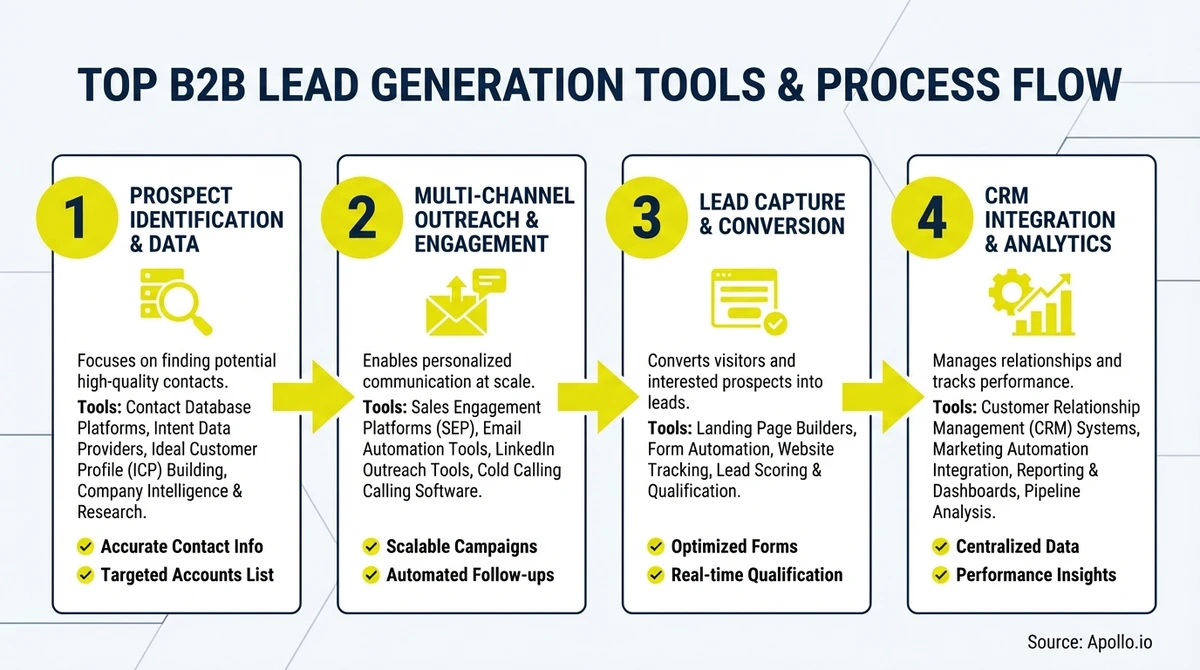
A successful B2B tech stack follows a linear flow: Prospecting Tools (e.g., Apollo.io) identify targets, data enrichment tools (e.g., Leadinfo) add firmographic context, and the CRM (e.g., HubSpot or Salesforce) acts as the central source of truth for lifecycle management and automation.
Advertisement
The Prospecting-to-CRM Workflow
Building a stack requires moving beyond simple contact lists. You must establish a pipeline where data flows from discovery to the central repository without manual intervention. For instance, a user might start on the Apollo.io platform to identify targets. While the Apollo.io free plan offers a limit of 5 credits/month, scaling requires upgrading to the Apollo.io Pro plan, priced at $29/user/month. A common failure mode occurs when teams attempt to export CSV files and manually upload them to their CRM, which creates immediate data decay. Instead, use direct integrations to ensure every new prospect is mapped to the correct owner instantly.
The Role of Data Enrichment
Raw contact data is rarely enough for complex B2B sales. You need intent signals to know when a company is actually in a buying window. Tools like Leadinfo provide these advanced intent signals, allowing sales teams to see which companies are visiting their site. If you use monday CRM, you can leverage its integration capacity of 200 different apps to connect these enrichment layers directly to your workflows. “The right CRM becomes the engine that drives new business,” according to monday.com. Without this connection, your sales team spends more time researching than selling.
- Prospecting Layer: Tools like Apollo.io for contact discovery.
- Enrichment Layer: Tools like Leadinfo for firmographic and intent data.
- Management Layer: CRMs like HubSpot or Salesforce for lifecycle tracking.
- Automation Layer: Integration platforms to connect the layers.
Why do B2B lead generation campaigns fail within the CRM?
Failure often stems from fragmented customer data, which is one of the biggest obstacles to effective lead scoring. When engagement history is siloed, the CRM cannot provide a unified view. This breakdown prevents the sales team from seeing the full buying committee and accurately prioritizing the pipeline.
The Speed-to-Lead Gap
Speed is the primary differentiator in conversion. “The company that responds first wins,” notes Cleverly. When a lead enters the CRM, every minute of delay reduces the probability of engagement. If your system does not trigger an immediate notification to an SDR, you create a “Ghost Lead”—a prospect who showed high intent but received no human contact. This is a critical failure mode that renders even the most expensive lead generation spend useless.
The Data Fragmentation Trap
Fragmented customer data is an obstacle to effective lead scoring. When contact information lives in a marketing tool, but engagement history lives in a separate email platform, the CRM cannot provide a unified view. This fragmentation prevents the sales team from seeing the full buying committee. To prevent this, ensure all touchpoints are synced to a single record. If you find yourself navigating to >Settings > Integrations > Data Sync to fix errors weekly, your architecture is broken.
Which CRM is best for your B2B lead generation model?
The best CRM depends on your team structure: HubSpot is ideal for all-in-one B2B SaaS, Salesforce scales for complex sales operations, Pipedrive suits sales-focused teams, and Close CRM is optimized for high-velocity inside sales and SDR teams.
Choosing the wrong platform can disrupt your growth. For example, a startup might find Salesforce too complex, while an enterprise may require the deep customization offered by Salesforce for complex SaaS sales operations. Match your tool to your volume to avoid early migration.
CRM Platform |
Primary Use Case |
Lead Gen Strength |
|---|---|---|
HubSpot |
All-in-One B2B SaaS |
Native marketing automation integration |
Salesforce |
Complex SaaS Sales Ops |
Deep customization and enterprise scale |
Pipedrive |
Sales-Focused SaaS Teams |
Visual pipeline management |
Close CRM |
Inside Sales & SDR Teams |
High-velocity calling and emailing |
Freshsales |
Budget-Friendly CRM |
Built-in lead intelligence features |
Evaluate these platforms based on their core functional strengths, such as HubSpot’s native automation or Salesforce’s enterprise scale, to find your best fit.
SaaS-Specific CRM Selection
For B2B SaaS companies, the CRM must handle recurring revenue models and complex subscription data. HubSpot Sales Hub, which has a starting price of $45/user/month, is a dominant player here because it bridges the gap between marketing and sales. In testing, I found that the seamless transition from a marketing contact to a sales deal in HubSpot reduces friction for SDRs compared to disconnected legacy systems.
Budget vs. Scalability
Budget constraints often lead companies toward Freshsales, which offers lead generation features at a lower entry point. However, scalability is the counterintuitive trap; a tool that is cheap today may become a bottleneck when your lead volume jumps from 50 to 5,000 per month. You must weigh the immediate cost savings against the future cost of data migration and lost productivity.
How does AI-powered lead scoring improve conversion rates?
Modern B2B CRMs provide AI-powered lead scoring features that help the sales team assess leads based on their likelihood to convert. These systems typically assign a score from 1-100. This automation is essential for maintaining pipeline velocity as your volume grows.
Manual lead scoring works when you have 50 leads a month. It breaks completely when you’re dealing with 500 or 5,000. This is where machine learning becomes essential for maintaining pipeline velocity. By analyzing historical data, AI can identify patterns that a human would miss, such as a specific combination of job title and recent webinar attendance that correlates with a closed-won deal.
Shortcut: To quickly access lead details in most modern CRMs, use the Cmd/Ctrl + F shortcut to jump to specific contact fields during a live call.
Rule-Based vs. AI-Assisted Scoring
Rule-based scoring relies on static “if-this-then-that” logic, such as “add 10 points if the lead is a CEO.” While simple, it is rigid. AI-assisted scoring, using tools like 6sense (an AI-driven intent data and ABM orchestration tool), looks at much more nuanced signals. For instance, 6sense can identify “dark social” signals or intent clusters that suggest a company is in an active buying cycle before they even fill out a form. Outfunnel is another specialized lead scoring tool that helps bridge this gap by providing deeper behavioral insights.
Implementing a Quarterly Scoring Review
Even with AI, your scoring model is not “set and forget.” You must perform a Quarterly Scoring Review. This involves auditing your current 1-100 score distribution against your actual closed-won deals. If your highest-scoring leads are consistently failing to move to the next stage, your model is misaligned with your current Ideal Customer Profile (ICP). “A basic model you actually use beats a complex one that sits unused in your CRM,” suggests Cleverly.
Should you outsource lead generation to an agency?
Outsourcing is a viable option for companies that need to scale quickly without hiring internal staff. Specialized firms like Callbox can provide a level of scale and B2B expertise that is often difficult to build in-house.
Deciding to outsource depends on whether your internal team can handle the technical complexity of modern prospecting. Companies like Callbox specialize in B2B lead generation and can provide a level of scale that is difficult to build in-house. However, the risk is a loss of brand voice and a potential disconnect between the agency’s messaging and your actual product capabilities.
Agency Pricing Models
When evaluating an agency, you will encounter three primary pricing structures:
- Subscription-based Models: Typically $500 to $5,000/month for ongoing prospecting and management.
- Custom Campaigns: Larger investments ranging from $2,000 to $50,000/month for highly targeted Account-Based Marketing (ABM).
- Pay-per-Lead: A variable cost model where you pay between $50 to $500 per qualified lead.
Inbound vs. Outbound Outsourcing
If your CRM is empty, you need an inbound strategy to build a sustainable top-of-funnel presence through content and SEO. Conversely, if your CRM is already full of low-quality leads, you likely need outbound help to identify and target high-value accounts through direct outreach.
FAQ
What is the difference between lead generation software and a CRM?
Lead generation software acts as the “hunter” to find and capture prospects, whereas a CRM serves as the “manager” to track the entire lifecycle from lead to closed-won. While software finds the target, the CRM ensures the relationship is managed through the full sales process.
How often should I review my lead scoring model?
You should perform a Quarterly Scoring Review tied to actual closed-won deals to ensure your scoring aligns with evolving Ideal Customer Profiles (ICPs). This prevents your sales team from wasting time on high-scoring leads that never actually convert into revenue.
Is manual lead scoring effective for growing B2B companies?
Manual scoring works for small volumes (approx. 50 leads/month) but breaks completely when scaling to 500 or 5,000 leads. As your volume increases, the complexity of tracking behavioral and firmographic signals manually becomes a bottleneck that leads to data errors and missed opportunities.
Advertisement