Advertisement
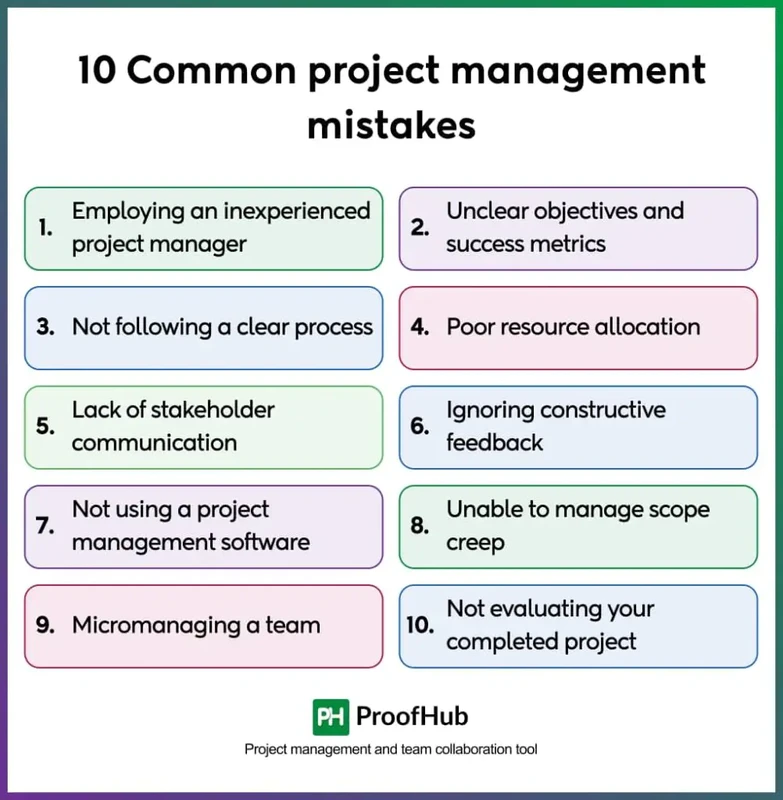
CRM FanzineFaves – Project management mistakes, ranging from scope creep to poor resource allocation, can cause up to 70% of initiatives to fail their objectives. These errors often lead to significant financial waste, with organizations losing approximately 10% of every dollar due to poor project performance and lack of formal management practices.
Research cited by PM 360 Consultancy Management indicates that 70% of projects fail to deliver what was promised. This massive failure rate suggests that even well-funded initiatives are vulnerable to systemic errors in execution and planning.
Why do project mistakes go undetected? The FMEA Framework
Mistakes often remain hidden because they are categorized by low detection difficulty and high severity. By applying a Failure Mode and Effects Analysis (FMEA) approach, managers can identify “silent killers” like scope creep before they escalate.
Advertisement
Even minor issues can escalate quickly if not addressed. Without a structured mechanism to flag deviations, a team may not recognize a crisis until the budget is already exhausted.
Categorizing by Detection Difficulty vs. Severity
The danger of an error lies in its visibility. Scope creep acts as a silent killer that erodes margins, making it harder to track than more obvious issues like resource underutilization.
Management Error |
Primary Impact |
Detection Difficulty |
Mitigation Strategy |
|---|---|---|---|
Scope Creep |
Budget and Timeline Overruns |
High (Silent) |
Formal Change Control |
Overutilization |
Team Burnout |
Medium |
Resource Leveling |
Underutilization |
Resource Waste |
Low |
Capacity Planning |
Documentation Debt |
Knowledge Loss |
High |
Centralized Wiki/Repo |
High detection difficulty makes errors like scope creep particularly dangerous. While overutilization impacts morale, documentation debt can persist for months before causing a failure during a handoff.
The Snowball Effect: From Minor Issues to Systemic Collapse
A single unaddressed requirement can trigger a chain reaction. Once a project is delivered, the most overlooked phase begins: evaluation. Without a structured review, teams repeat the same mistakes.
How do modern workspace dynamics create new failure modes?
Modern mistakes stem from ‘Documentation Debt’ in asynchronous environments and ‘Time-Zone Blindness.’ Unlike traditional errors, these digital-first failures occur when decisions made in Slack or Teams are not recorded in a central source of truth, leading to visibility gaps and misalignment.
Starting without goals can lead to a lot of motion, but not much progress. In remote settings, this results in teams working intensely on tasks that do not align with the primary objective.
The Documentation Debt in Asynchronous Teams
In my experience, the most frequent failure mode in distributed teams is the “Chat-to-Task Gap.” This happens when a critical architectural decision is made in a Slack channel but never updated in the project management tool like Wrike or Jira. To prevent this, managers should enforce a rule: if it isn’t in the official documentation, it didn’t happen.
Common communication pitfalls include:
- Team silos where departments operate without stakeholder engagement.
- Information fragmentation across multiple messaging platforms.
- Lack of centralized decision logs, leading to “re-deciding” the same issues.
The Tooling Complexity Audit: When software becomes a mistake
Software overhead can become a liability. If the time spent managing a tool’s interface exceeds the time saved by its use, the tool contributes to project failure.
What are the most common resource management errors?
Overloading team members, underestimating the time required for tasks, or failing to allocate adequate budget can lead to burnout, missed deadlines, and budget overruns.
Poor resource allocation can lead to burnout and budget overruns. When a manager overloads a single developer with 50+ hours of work per week, they are not just risking a delay; they are risking the total loss of that individual’s productivity due to exhaustion. Conversely, leaving highly skilled engineers with no assigned tasks creates significant financial waste.
Resource State |
Primary Consequence |
Financial Impact |
Long-term Risk |
|---|---|---|---|
Overutilization |
Burnout & Errors |
High (Turnover costs) |
Critical Talent Loss |
Underutilization |
Idle Capacity |
High (Sunk Salary) |
Budget Cuts |
Resource failure is often a matter of planning. Overutilization stems from poor risk management, whereas underutilization is a failure of capacity planning.
The Burnout Trap: Overloading and Underestimating
Many managers fall into the trap of assuming 100% capacity is the goal. This is a fallacy. If a team member is booked at 100% capacity, they have zero buffer for the inevitable “emergency” tasks that arise. This lack of buffer is a primary driver of missed deadlines.
The Waste Factor: The Hidden Cost of Underutilization
Underutilization of resources creates waste and jeopardizes the availability of those resources in the future. If a specialized consultant is hired for a 3-month project but only assigned work for 1.5 months, the organization has effectively wasted 50% of that contract’s value. This inefficiency can lead to future budget reductions for the entire department.
The 8-Person Threshold for Managerial Span of Control
A specific structural mistake occurs when a project manager attempts to oversee too many direct reports. There is a recognized threshold of 8 individuals, above which a project manager may find it difficult to maintain effective communication and oversight. Once a team exceeds this number, the manager often loses the ability to track individual progress accurately, leading to a breakdown in accountability.
How can you implement a Project Recovery Protocol?
When a project begins to fail, implement a recovery protocol: 1) Halt non-essential scope changes, 2) Re-evaluate the S.M.A.R.T. goals, 3) Conduct a mid-project risk assessment, and 4) Re-align resources using a formal change control process.
If you notice a project is drifting, do not simply “work harder.” This is a counterintuitive mistake; increasing intensity on a flawed plan only accelerates the failure. Instead, you must pause to reassess the fundamental project parameters. This is where S.M.A.R.T. goals—Specific, Measurable, Achievable, Realistic, and Time-bound—become critical for stabilization.
Shortcut: To quickly assess project health, use the “Red-Amber-Green” (RAG) status check in your reporting dashboard to identify which workstreams require immediate intervention.
Step-by-Step Mid-Project Course Correction
Recovery begins by freezing the scope to prevent uncontrolled change requests. Following this, conduct a formal Risk Management review to assess likelihood and impact, identifying what can be salvaged.
Using PDCA to Stabilize Drifting Timelines
The PDCA (Plan-Do-Check-Act) cycle is an essential framework for recovery. During the “Check” phase, you must compare actual progress against the original baseline. If the variance is greater than 15%, the “Act” phase must involve a formal re-baselining of the project schedule rather than just hoping for the best.
Why does formal project management increase success rates?
Formal project management practices make projects up to 2.5 times more likely to succeed. By utilizing structured frameworks like the PDCA cycle and Kaizen, organizations can reduce failure rates by up to 63% through strategic vision and leadership.
As Mark Langley, former PMI president, stated, “if your organization is not good at project management, you are putting its strategy at risk.” This highlights that project management is not just a tactical necessity but a strategic one. Without it, the gap between high-level vision and ground-level execution becomes unbridgeable.
The Economic Impact of Professional Standards
The financial benefits of formalization are measurable. Organizations that adopt standardized methodologies see significantly higher ROI because they minimize the 10% waste associated with poor performance. Professional standards provide a common language for stakeholders, reducing the friction that causes delays.
- Increased predictability in budget forecasting.
- Improved resource utilization through data-driven planning.
- Higher stakeholder confidence through transparent reporting.
Lessons from Massive Failures: The Berlin Brandenburg Case
The Berlin Brandenburg Airport serves as a cautionary tale of what happens when formal management and oversight fail. The project experienced a decade of delays and massive cost overruns, largely due to technical complexities and poor coordination. It demonstrates that even massive infrastructure projects cannot survive without rigorous, disciplined management frameworks.
FAQ
How much money do organizations lose to poor project management?
Organizations waste approximately 10% of every dollar due to poor project performance, as noted by PMI research. This loss stems from inefficient resource use, scope creep, and the inability to meet original project objectives.
What is the best way to prevent scope creep?
The most effective way to prevent scope creep is to implement a formal change control process and utilize S.M.A.R.T. goals. This ensures that every new requirement is evaluated against the project’s original objectives and budget before being approved.
Why is the evaluation phase so important?
Neglecting the evaluation phase leads to the repetition of mistakes. A structured review, utilizing frameworks like Kaizen or the PDCA cycle, allows teams to identify systemic issues and implement continuous improvements for future projects.
Advertisement