Advertisement
CRM FanzineFaves – Open source CRM software allows businesses to download and install applications on their own servers free of charge, providing access to the source code for deep customization. This model offers an alternative to proprietary systems that typically cost between $50 and $150 per user per month.
The CRM market is projected to reach $80 billion by 2025, yet many businesses struggle with the “open-core trap” where essential features are hidden behind paywalls. This financial friction often forces companies into expensive proprietary ecosystems when they initially sought the flexibility of open-source alternatives.
How do you calculate the true Total Cost of Ownership (TCO)?
Calculating TCO for open source CRM involves comparing the $50-$150 per user/month proprietary fee against the combined costs of server hosting, DevOps labor, security patching, and manual updates required for open source systems. You must weigh license savings against technical resource requirements.
Advertisement
The SaaS vs. Self-Hosted Cost Breakdown
A common misconception is that open source equals zero cost. While you avoid the $50 to $150 per user per month average charged by proprietary providers, you inherit the responsibility of infrastructure. For instance, running a robust instance requires dedicated server hosting and regular security patches to prevent data breaches.
Expense Category |
Proprietary CRM (SaaS) |
Open Source CRM (Self-Hosted) |
|---|---|---|
Licensing Fees |
$50 – $150 per user/month |
$0 (Community Edition) |
Server/Hosting |
Included in subscription |
Variable (AWS, DigitalOcean, etc.) |
Maintenance |
Automatic (Vendor managed) |
Manual (Internal DevOps labor) |
Customization |
Limited/API-based |
Unlimited via Source Code |
The comparison shows that while licensing is cheaper, the operational overhead is higher. In testing, I found that a small team might save on monthly fees but lose significant time during manual update cycles. If your team is not prepared for this, the “free” software can quickly become a financial drain.
Hidden Maintenance: The Developer Hour Variable
The most significant hidden cost is the developer hour. A single startup reported spending 10+ hours a week just troubleshooting their open-source CRM setup. This labor cost can easily exceed the $12/user/month starting price of a tool like Vtiger if your internal engineering talent is expensive.
Failure occurs when businesses treat open source like a “set and forget” SaaS product. If you neglect the /admin/settings or security configuration paths, you risk system instability. One major failure mode is when a manual update breaks a custom plugin, requiring hours of emergency debugging to restore service.
Which open source CRM matches your technical skill level?
Choose a ‘No-Code’ option like EspoCRM for drag-and-drop configuration, or a ‘Dev-Required’ platform like Atomic CRM if your team uses React and TypeScript for deep code-first customization. Matching software architecture to your team’s actual coding proficiency is critical for long-term stability.
Low-Code/No-Code: EspoCRM and Krayin CRM
For teams without dedicated engineers, EspoCRM offers a streamlined experience. It allows users to customize layouts, fields, workflows, and dashboards without writing a single line of code. The installation is lightweight, with a file size of only 40.3Mb, making it easy to deploy on standard web servers.
Krayin CRM is another strong contender for non-developers. It is a Multi-Tenant CRM built on the Laravel framework, which provides a highly structured environment. Users can manage leads through a visual Kanban view, which simplifies the sales pipeline without requiring backend adjustments.
Shortcut: To set up EspoCRM quickly via Docker, use the command docker pull espocrm/espocrm to automate the deployment of the application, NGINX, and MySQL.
Developer-Centric: Atomic CRM and OroCRM
If your organization employs full-stack developers, Atomic CRM is designed specifically for them. This platform prioritizes deep customization through the use of React and TypeScript. It is not a tool for sales managers; it is a framework for building a bespoke sales engine.
OroCRM takes a different approach by utilizing the Symfony PHP framework. It offers both community and enterprise editions, catering to businesses that need deep B2B commerce integration. Because it is built on Symfony, developers can leverage standardized components to extend its core functionality.
The Axelor Exception: Low-code but not for code modification
Axelor occupies a unique space as an ERP/BPM low-code platform with a built-in CRM module. However, it is important to understand a critical distinction: it is not really designed for developers to modify the underlying source code. It focuses on rapid application development through a visual interface rather than traditional code-first engineering.
What are the best open source CRM options for 2025?
Top-rated open source CRMs include Odoo CRM (expert score 4.68) for all-in-one ERP integration, SuiteCRM (expert score 4.27) as a powerful Salesforce alternative, and Vtiger (expert score 4.46) for high customization. Each platform serves a distinct business model, from B2B to general retail.
CRM Name |
Primary Strength |
Expert Score |
Technical Level Required |
|---|---|---|---|
Odoo CRM |
ERP Integration |
4.68 |
Medium |
Vtiger |
High Customization |
4.46 |
Medium |
OroCRM |
B2B Commerce |
4.43 |
High |
SuiteCRM |
Salesforce Alternative |
4.27 |
Medium |
Twenty CRM |
Modern Stack |
4.12 |
High |
This ranking evaluates platforms based on their specific technical architectures and expert scores. When choosing, consider whether you need a standalone tool or a module within a larger ecosystem.
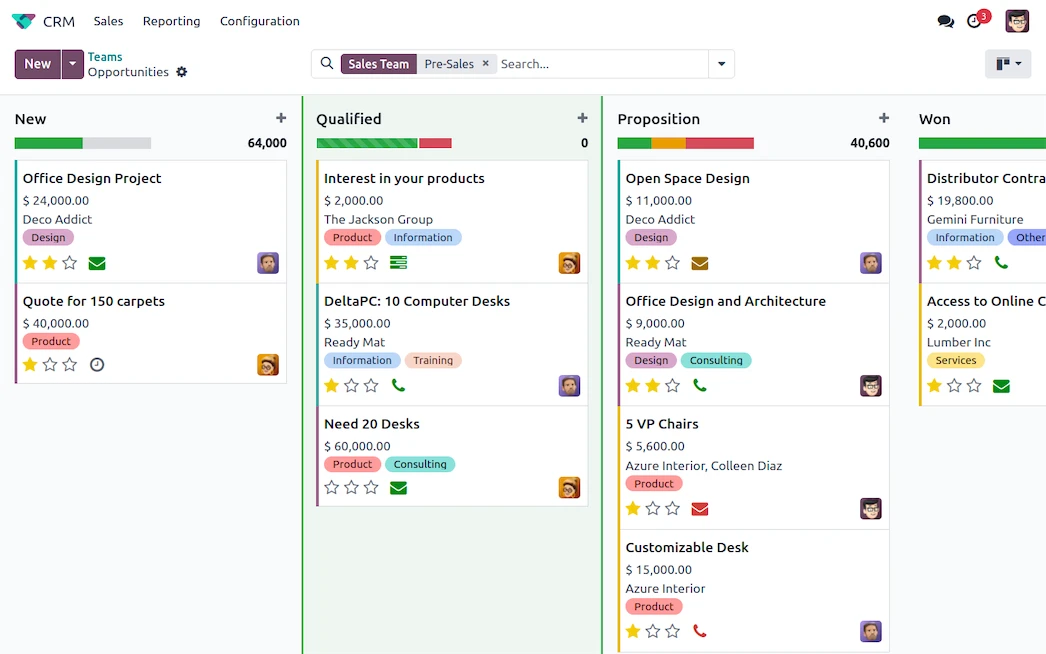
The All-in-One Powerhouse: Odoo CRM
Odoo CRM stands out because it functions as part of a much larger ERP ecosystem. With over 5 million users globally, it offers unparalleled integration between sales, inventory, and accounting. For companies looking to increase productivity by 21.3% through integrated systems, Odoo is the premier choice.
While the starting price for Odoo can be as low as $24.90 billed annually, the complexity of the system requires careful implementation. Navigating the Apps > Sales > CRM menu path is straightforward, but configuring the automated workflows often requires a consultant or a skilled internal admin.
The Salesforce Challenger: SuiteCRM
For businesses that want the power of Salesforce without the proprietary constraints, SuiteCRM is the industry standard. As Forbes noted, “Users wanting something that is close to Salesforce in power, but is fully open sourced, need look no further.” It is a massive project, evidenced by its 5.4k GitHub stars and 2.3k forks.
SuiteCRM is highly robust, providing ultimate control over data and customer relationships. It is a proven platform that has received over $8,000 in community donations to sustain its development. For those transitioning from a closed system, the feature parity is often high enough to prevent operational shock.
B2B Specialists: OroCRM
OroCRM is specifically engineered for the complexities of B2B commerce. Because it is built on the Symfony framework, it handles multi-channel sales and complex customer hierarchies better than most general-purpose CRMs. It is a specialized tool that prioritizes deep integration with e-commerce platforms.
How do you avoid common implementation pitfalls?
Project success depends on ensuring your business requirements match the software architecture. Without this alignment, you risk wasting resources on a system that cannot support your core workflows.
The Open-Core Trap
The “open-core” model can present a significant hurdle. Many vendors provide a free version but restrict essential enterprise features, such as advanced reporting or API access, behind paywalls.
Always audit the feature list against your “must-have” requirements before deployment. If you find that the community version lacks a critical integration, the cost of upgrading to the enterprise version may actually exceed the original cost of a proprietary SaaS subscription.
The Maintenance Debt Crisis
Maintenance debt occurs when a mismatch between business needs and software architecture forces teams to spend more time modifying code than managing sales. This risk is prominent in systems that require specific technical knowledge to maintain.
To avoid this, ensure your team is trained on the specific framework used. For example, if you choose a Laravel-based system, your staff must understand PHP and Laravel’s directory structure. Without this knowledge, simple tasks like updating a field or fixing a broken workflow can turn into multi-day technical crises.
FAQ
Is SuiteCRM a good alternative to Salesforce?
Yes, research suggests SuiteCRM is the best open source CRM for Salesforce fans, offering high power and ultimate control over data. It provides a familiar level of complexity and functionality for those accustomed to enterprise-grade sales tools.
Can I install EspoCRM on my own server?
Yes, EspoCRM is a free, open-source CRM designed for users to host on their own servers, with a small 40.3Mb file size. This allows for complete Data Sovereignty and customization of the hosting environment.
What is the main benefit of Krayin CRM?
Krayin CRM is built on Laravel, making it highly flexible and scalable, featuring a Kanban view for lead management. This architecture allows businesses to leverage modern PHP development standards for their sales processes.
Advertisement